

In this part of Wales, Niall and I were absolutely spoilt for choice when it came to abandoned mines. But it was one in particular that we were after. This was the so-called "Cavern of Lost Souls," named as such because... you know what? I don't even know. I don't understand the logic behind urbex codenames. Whatever rakes in the clicks, I guess.
The mine became infamous because back in the 1970s the locals got into the habit of dropping all of their old cars down a mine shaft, and this has gradually caused a huge underground mountain of scrap to protrude from a big underground lake. No lost souls involved. Leave it to the urbex community to romanticise fly-tipping for Youtube ad revenue. The underground mountain, or undergrountain (much better name than cavern of lost souls), consists of dead automobiles, refrigerators, televisions and other household appliances, and it genuinely looks quite pretty, sticking out of a lake with just a stream of light shining on them from the mine shaft above.
Naturally I wanted to see it for myself, but getting down there was going to be an adventure.
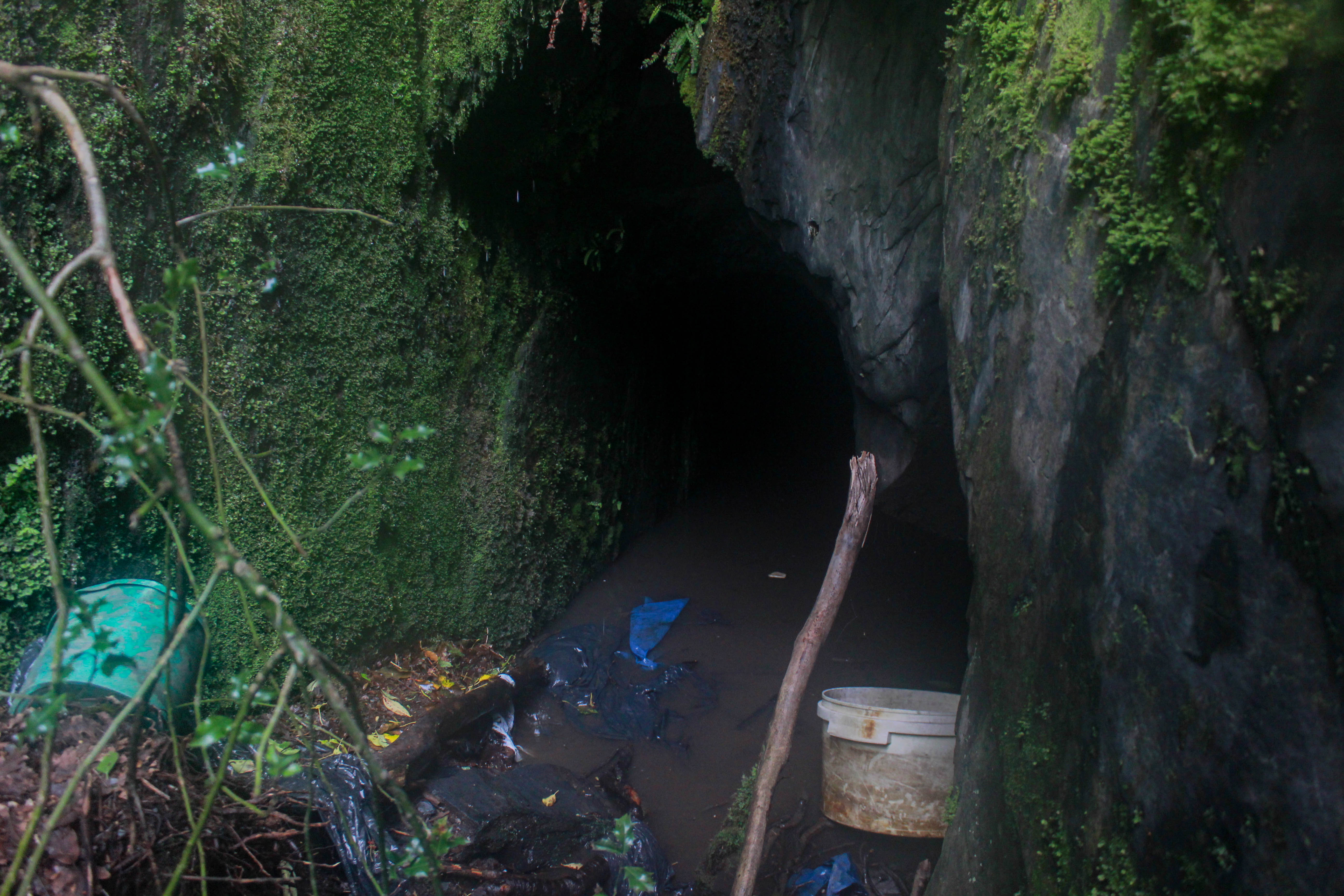
The entrance to the mine was pretty easy to find. Some of the lazier fly-tippers can't even be arsed to lug their rubbish a few more feet to the shaft, and have just left it all piled up next to it. The entrance tunnel is behind a big pile of litter, and it's a little bit flooded.

An old TV is bobbing up and down in the water, which is a few feet deep and pretty damn murky. As we waded through the tunnel, I could feel other rubbish brushing against my legs. I couldn't even see half of it. I'd lift my foot and there would be bin bags coming up with it. I have no idea what I'm walking in.

Eventually the tunnel opens up into a cavern, and if you look closely, the old narrow-gauge track rails are still on the ground! See, I know that car graveyards are popular, but I don't understand why more people don't point out that the mine tracks are still here. That's history right there!

As for the history of the mine, it was established in 1820 for the purpose of mining slate, although I read that black shale was also found here. Now prior to writing this, I had no idea what black shale was. Shale itself is apparently the most common sedimentary rock, and it can be found in various different colours depending on what minerals are present in it. Black shale apparently contains trapped organic matter that can be converted into petroleum. That's pretty cool.
I guess there's almost a poetic aspect in that cars containing fuel were returned to the Earth from which the petroleum came, but let's face it, that was probably lost on whoever had the bright idea to drop cars down here in the first place. I imagine the train of thought was more along the lines of "Hey, I can just drop my old car down this hole and nobody will ever know.... Whoa!!!! That was a big splash! Let's do it again! Brian, how much do you like that pinto?"
So allegedly the mine was struggling in 1848, due to financial mismanagement from the slate company. This resulted in its initial closure, but the area was still full of minerals and the mine was reopened in 1859. By 1873, two hundred people worked here and eventually its growth, along with a spectacular tramway, allowed it to amalgamate with other mines in the area in 1884, although one source says 1901.
Apparently it closed initially in 1906 when nobody wanted slate anymore, but it opened again at some point after the first world war, before closing for good in 1971. It became a car dumping ground very soon after. The Who and Why of the situation has been widely speculated with the finger often pointed at the local council, but I think after all these decades we'll never know for sure. Someone somewhere probably knows but given the environmental impact of this place being a potential scandal, I imagine they're remaining tight lipped.

Here's a closer look at the rails still leading into the mine.

And if you look closely, you can see where the tracks separate to go up onto two different tiers on the side of a great big void. It was here that things were going to get interesting.

In the ceiling there are still bits of metal that probably would have been used to haul stuff up back in the day, and load them into the old mine carts that ran along these ledges.

Ultimately we had to descend down these ledges to get to the car mountain. It was a task I wasn't going to shy away from, but I do have dyspraxia that blesses me with terrible depth perception along with all the physical co-ordination and grace of a satsuma. I'm not one for letting it impair my life too much. There are plenty who would say "I would do that, but...," before dropping an excuse that prevents them from doing what they really want to do. I try to replace "I would, but..." with "I could, if...," meanng that whatevers in my way is an obstacle rather than an obstruction. An obstacle can be dealt with.
But let's not forget that it was also pitch black in here too!
To climb down we'd be relying entirely on head torches, so we wouldn't be able to even see the bottom until we were there.
Heights aren't really an issue for me. As any long-time reader of the blog will know, I absolutely love rooftopping, and this is probably no higher than most of the stuff I've climbed. But for some reason being underground in the dark makes it all the more disconcerting. One wrong move here and things could get very ugly.

Fortunately those who have come before us have left their ropes still here and dangling over the edge. That was quite convenient. Suddenly the descent was looking a little more doable.
While Niall checked the integrity of the rope, I added the final touches to my will, and then we were off to meet our splattery end.

Down below in the depths we can just about make out some graffiti. It's not even good graffiti. It's my-parents-are-siblings graffiti. I mean, if you are going to lug cans of spray paint down a mine, at least do something creative. I would love to climb down a mine and find that someone had painted a brilliant piece of art that would only be appreciated by others who make the effort to see it. That would be amazing! But instead we have this/
On the bright side, I guess if semi-evolved Jeremy Kyle guests can make the climb then so can I.
On the other hand, they probably just dived off the edge and survived because of their super dense neanderthal brow.
Nevertheless, we made our way down. It was easier than I'd heard it was, but I absolutely recommend bringing a friend for this sort of thing.

I'm not a big fan of the graffiti, but it is interesting that these are urbexers, given that whenever people are reluctant to share where locations are, due to high publicity leading to places getting ruined, the standard response is "It's not people in the urbex world who ruin places, it's local kids."
In this case the vandals certainly seem to be immersed enough in the urbex crowd to namedrop specific websites, but hey-ho. Everyone knows that once a location gets shared out and starts trending among the urbex scene, it's all downhill from there, and this place is no different. Anyone who thinks otherwise is either naive or a total moron.
We're very much late to the party with this place, the so-called cavern of lost souls. It's been smeared across the internet, gained its silly nickname, and it's reached the point that the mere presence of an underground car graveyard just doesn't incite as much sensation as it used to, and youtubers are doing silly things like planting "mystical" artefacts that only they somehow manage to find, just to have something new to say about it.
I was expecting it to be a little bit littered. The graffiti doesn't surprise me.
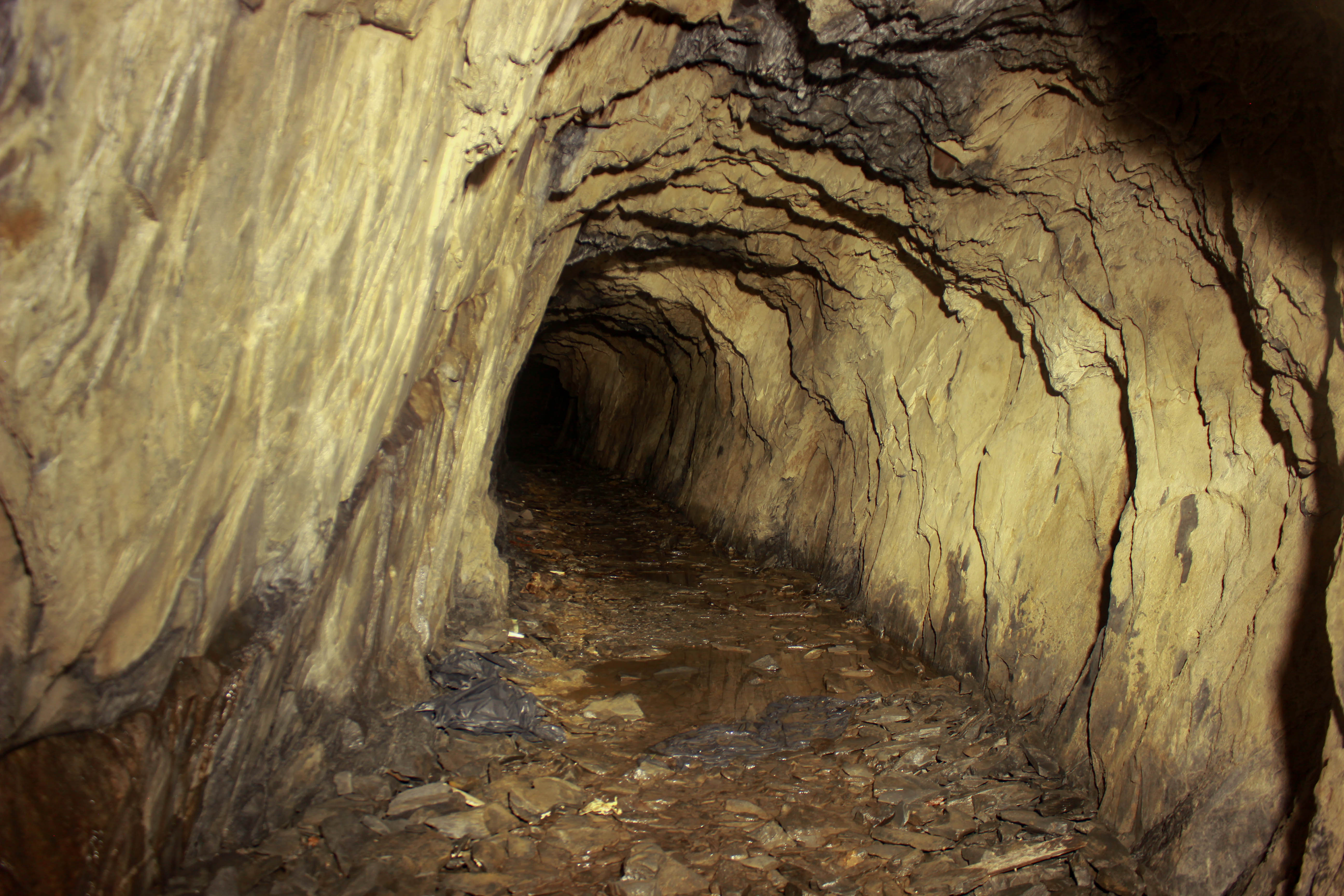
The tunnel continues from this chamber, back in the same direction that the original entry tunnel had come from, albeit considerably deeper.


But then the tunnel double backs on itself, so I decided to have a mooch down there.

There are horizontal grooves in the floor here that show where the old trackbed used to be. This is so awesome and really drives home the history of the place. A hundred years ago carts would have come up here carrying all the slate to be hauled up to the surface. It's a shame the tracks aren't still there.

It looks like it was going to fork again, but in this case the tunnel on the right looks like it was never started, while the tunnel on the left looks like it has collapsed.
It was back to the main passage for me.

There was one passage left before we got what we came for.

And here it is:

It's sort of like that scene from The Simpsons where Homer tries to build a barbecue, and we have a shot of the completed product with Homer saying "That's one fine looking barbecue," before the camera pans out, we realise it's just the picture on the packaging, and Homer lowers it to reveal his pile of trash, crying out "Why doesn't mine look like that???"
You see, there are plenty of photos of this chamber that show the undergrountain sticking out of clean, unlittered water, and beautifully reflected on its clear surface, but those images are old and the sight is now completely different. Hundreds of people have come here since then, and none of them have cleaned up after themselves. Some have seemingly brought entire picnics and left the litter behind. Others have brought rubber boats and just abandoned them, leaving them floating in the water. Many urbexers now refer to it as the Cavern of Lost Dinghies, which is absolutely more accurate than the cavern of lost souls.
It's pretty sad. If any area proves the point of why locations shouldn't be shared around, it's this place.
Even so, it was still amazing to be here, in such a large underground chamber, with sunlight streaming down the mine shaft onto a pile of several hundred cars. These photos don't capture the scale of the place. It was huge.

Zooming in, we can make out the cars a bit better. And just think, this pile continues far below water level. There are videos online of underwater drone footage that shows that the bottom of the lake is absolutely littered with dead automobiles. What we're seeing here is just the top of the car pile.
It's a total abuse of the local environment but still, it was a sight to behold.
I always try to put myself into the shoes of the people that a location mattered to before it was abandoned.
Once long ago an innocent mine explorers jaw hit the floor when they first discovered this, thinking that they'd just be exploring a regular mine.
And then years before that someone once pushed the first car down that mine shaft, not even sure what would happen, hearing silence for a moment before a massive weirdly satisfying splash as it hit the lake. That must have been pretty cool, let's be honest.
And then before that, these cars were owned by real people and families in the 1960s and 1970s. If it's true that these were mostly all dropped down here in the 1970s then there are adults alive today who will have sat in the back seats of these specific cars when they were children.
And then before that, the mining industry was once the beating heart of a thriving economy. This mine once mattered to two hundred people who wanted to put food on the table for their families.This entire area with the shaft up to the surface would have been a hive of activity as thousands of tons of slate was hauled to the surface. And if the mine closed in 1971 then there could well be retired miners still alive today who will remember it as it was.
It doesn't need clickbait. It doesn't need youtubers to pretend to find
magical swords for clicks and views. It doesn't need a lame nickname.
The truth is enough.
And doesn't it just play with the imagination? This is as far down as we can go but that doesn't mean it's the end of the mine. There could be other tunnels leading off from this chamber below the waters surface. There could still be tracks and even mine carts sealed away by a heap of water mixed with rusty metal, antifreeze, petrol, broken glass and probably urine, and it will all go unexplored for as long as the water is here.
Only one thing was left to do. I picked the least deflated dinghie and started to blow it back up. I was going to set foot on the undergroundtain.

(Photo credit: Niall)
Wooo!!! Look at me go! Pirate hat and everything. I actually gave it a pretty serious attempt.
Alas, it was not to be. I don't know if the boat scraped any junk below the surface or if it was always a bit naff, but suddenly I had water on board, accompanied by a quiet but noticable hissing sound. I was totally Albert-Alexandering this shit! Fuck!
Luckily Niall had a grappling hook on a rope and he saved my soggy ass.
Having narrowly avoided hypothermia as well as swimming in highly contaminated water full of rusty pointy things, we decided to call it a day and head for the surface.
But before we conclude, there are surface features that deserve a mention!

This contraption would have lowered the slate from the mines down the mountain, where it would have then been loaded into trains.

It seems to be in surprisingly good condition, still retaining most of the wooden panels, the metal wheels and even the metal cable hanging limply on the incline.

I think that this could actually be restored with a little TLC, although with the mine closed there would be little point.
It was as we were leaving that we bumped into some mine explorers. These guys were serious, all decked out in proper mining gear that made us look like amateurs. Sexy amateurs, but amateurs nonetheless. They somehow saw through this, or maybe they wanted us to die a horrible death, because they told us about a much larger mine, much more amazing than this one, which still had some great stuff left behind. The adventure continues... in the next blog.

To conclude, the car mine is pretty cool, and definitely one to tick off the list for novelty reasons more than anything. On a serious note, it is a major fly-tipping dump, and ideally it should be cleaned up. But until that happens, if you want to visit it then bring friends who are at least semi-competent climbers. Head torches and gloves are also ideal. It's not an overly challenging climb but it is still a step up from a lot of other places, and caution is advised. I personally think that there's enough idiots in the urbex game now that it's a shame amazing nobody has died here already. If you're not a climber, there's no shame in sitting this one out. There's plenty of other things to see in the area, like hiking routes and wild swimming spots, so if you're the wussy one in your friend group, you can wait for them to be finished checking out the mine and still have a good day.
That's all I've got. My next blog is another mine, and then after that I'm returning to the Shropshire blog to look at some military base and publish some photos from a shoot I did last summer. In the meantime, I'm active on the social media hellscapes that are Instagram, Vero and Reddit, as well as the ones everyone hates, Facebook and Twitter. Give me a follow if you want to catch future blogs.
Thanks for reading!


